#039
Explore the future of
organizations Looking ahead
to technological and
social advancements
Takumi Shimizu
Japanese Color: Ebicha-iro

#039
Takumi Shimizu
Japanese Color: Ebicha-iro
MOVIE

Associate Professor
Graduate School of Media and Governance
Organizations have traditionally been understood as forms of face-to-face collaboration defined by clear boundaries and membership. This notion has changed significantly with recent technological and social advances, as well as the impacts of the COVID-19 pandemic. New forms of working and organizing have emerged through more fluid connections enabled by digital technologies. Collaboration with nonhuman actors such as AI and robots is also reshaping how we think about organizations. In this context, Dr. Takumi Shimizu explores the future of organizations and how they may continue to evolve.
Organizations in various forms, including businesses, central and local governments, and communities, are all constantly evolving to keep pace with the times. Advances in technology, including the emergence of generative AI and digital platforms, have given rise to new ways of working and new organizational forms, while also enabling remote work and greater operational efficiency. Also, social changes, including growing expectations for diversity and inclusion, are reshaping recruitment and human resource management.
These changes create new possibilities for organizations, but simply introducing new technologies does not automatically lead to better performance. One expected scenario is that digital technology will be applied for remote work options to be adopted widely, freeing employees from the traditional office-bound work model and creating an organizational environment in which members can engage in their duties without being constrained by time or location. This will enable organizations to attract leading talent, regardless of physical distance. It will also encourage those who find it difficult to work full-time in an office, mostly because of family-care responsibilities, to continue to pursue their career, thereby achieving a mutually beneficial solution.
At the same time, organizations are facing new challenges, such as reduced spontaneous interactions, limited cross-departmental collaboration, a weakening sense of belonging, and difficulties in developing their corporate culture. My research explores the “future of organizations” from a variety of perspectives, taking both these possibilities and challenges into account. I believe that rethinking how organizations should work in the future is directly connected to improving people’s lives.
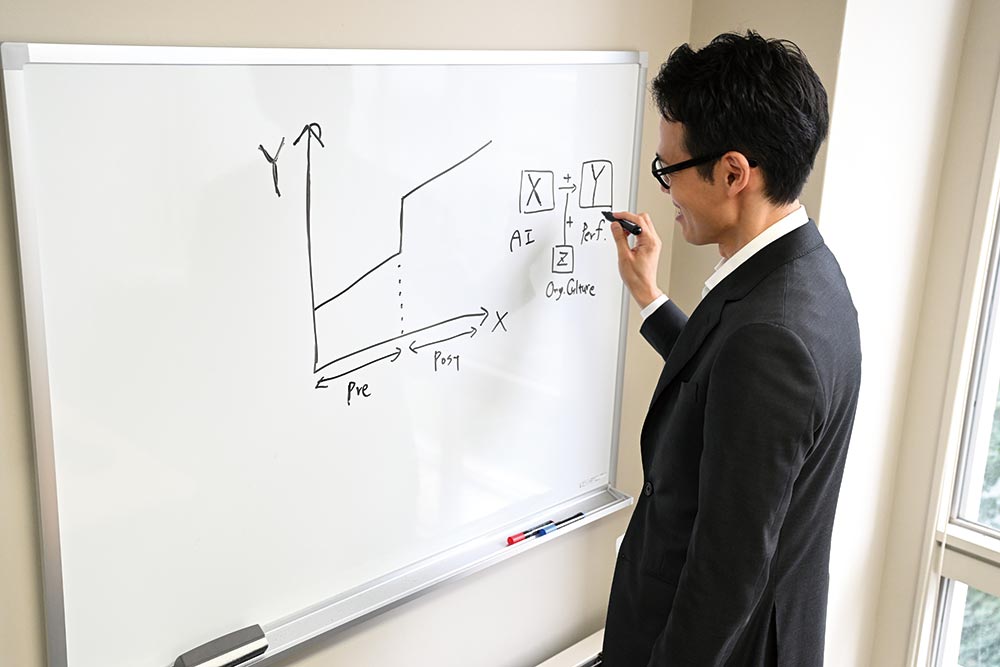
One of my major recent research themes is the impact of generative AI on organizations. What kind of organizations can make effective use of generative AI and other digital technologies to improve their performance? To investigate this question, we conducted surveys of companies listed on the Tokyo Stock Exchange.
Specifically, we collected data on the extent to which organizations are using generative AI and on the organizational culture that supports such use—what we refer to as digital cultural capital—and statistically analyzed how these factors are associated with firms’ financial performance. Our findings showed a positive relationship between generative AI use and firm performance among firms with high levels of digital cultural capital. Among firms with low levels of digital cultural capital, however, no such relationship was observed. This suggests that what matters is not simply adopting a technology, but developing the organizational capabilities needed to embed it in work processes, decision-making, and collaboration and ultimately translate its use into tangible outcomes.
In the field of AI-related research, our lab is promoting student-led projects on subjects such as “Information environment of organizations in the era of generative AI,” “Behavioral changes among managers with generative AI,” and “The fairness of AI feedback in performance appraisal.” Rather than confining these research findings to the academic realm, we aim to generate, disseminate, and apply them as practical insights that help real-world organizations envision their futures.
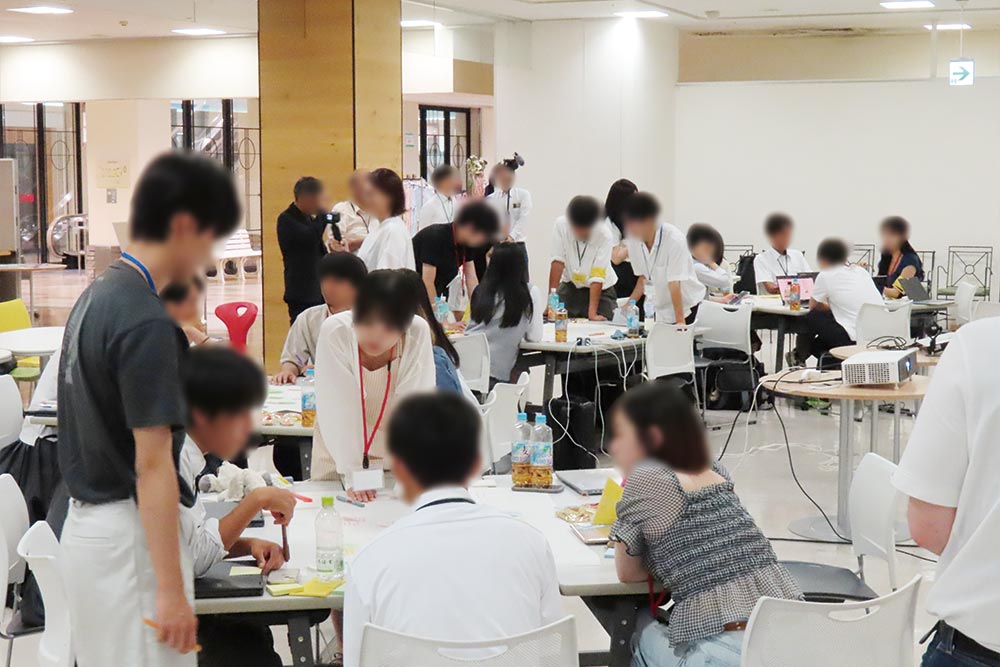
I also study regional communities from the perspective of organizing and collaboration, asking questions such as, “How does technology change cities and the activities of the people who live in them?” In line with this, we are promoting the Tsuyama Smart City Initiative, a joint research project with Tsuyama City in Okayama Prefecture. It is an industry-academia-government collaboration involving the Tsuyama City government and the relevant local app providers while also engaging students from our lab.
The project entails visualizing and analyzing the health status of citizens based on data accumulated by the health management app they use. We are also considering a plan to recruit residents to participate in the project, collect additional data, and run pilot programs for various measures designed to encourage behavioral change. These are aimed towards the ultimate goal of using the research results to formulate data- and evidence-based health promotion strategies.
At first glance, this type of research may seem to fall outside the conventional boundaries of organization studies. However, we believe that our knowledge can contribute to understanding how communities are organized and how multiple organizations can collaborate to build and sustain them. As digital technologies become more deeply embedded in society, the boundaries between organizations and communities are becoming increasingly blurred, and participation is becoming more fluid. For this reason, rather than viewing organizations as fixed entities, we take a broader perspective and see them as arrangements through which diverse actors come together and collaborate. Exploring organizations from this wider perspective is a central part of our research.
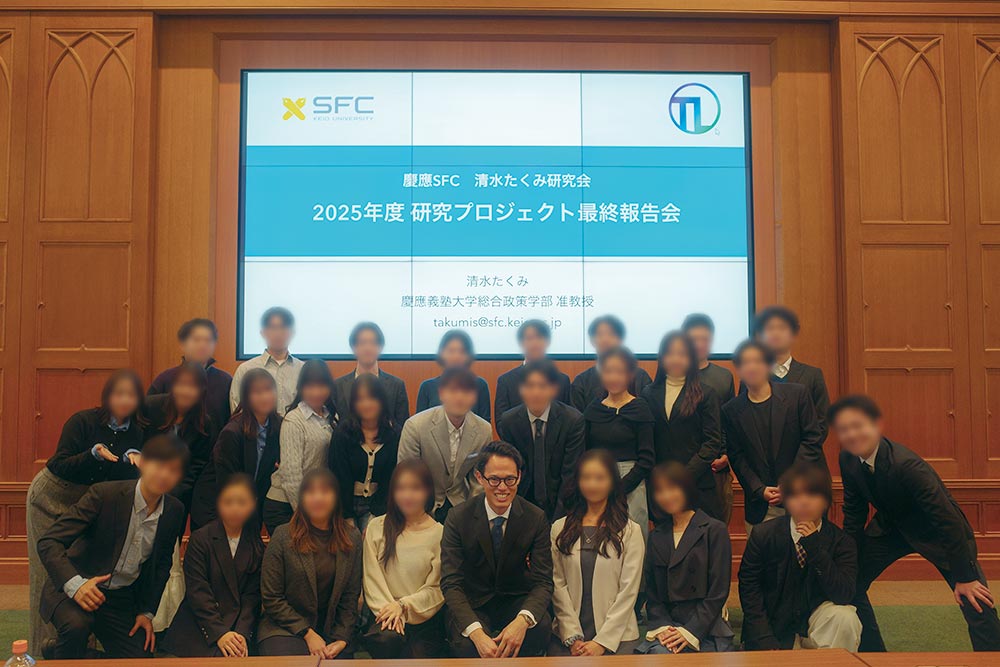
Takumi Shimizu
Associate Professor, Faculty of Policy Management, Keio University. After graduating from the Faculty of Policy Management at Keio University, he worked as a strategy consultant at Roland Berger. He subsequently earned a Ph.D. in Management from McGill University and served as an Associate Professor at Waseda Business School before assuming his current position in 2021. His major fields of specialization are management information systems and organization studies. His research focuses particularly on how technological and social change affects management and organizations. His research interests include the future of organizations and work, remote/hybrid work, digital organizational culture, utilization of data, algorithm and AI technologies for business and organizations, open innovation, online communities, and smart cities.
2026.Nov ISSUE
Share this article


Keio Research Institute at SFC
Office of Research Development and Sponsored Projects, Shonan Fujisawa Campus, Keio University
5322 Endo, Fujisawa, Kanagawa, 252-0882, Japan
E-mail: info-kri[at]sfc.keio.ac.jp
© Keio University. All rights reserved.
